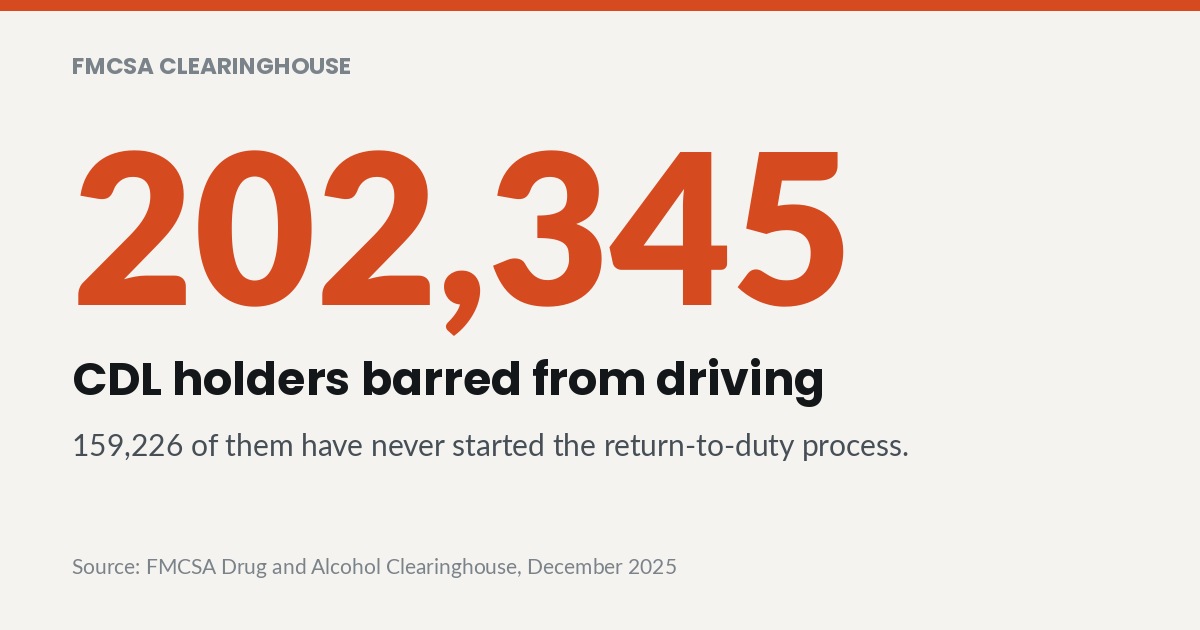
FMCSA compliance services cover Clearinghouse queries, driver qualification files, testing programs, and return-to-duty tracking. The point most carriers miss is that these functions govern capacity. The FMCSA Drug and Alcohol Clearinghouse counted 202,345 CDL and CLP holders in Prohibited status in December 2025. That parked capacity is a planning problem, not paperwork.
The Shortage Argument Ignores a Counted Population
Industry groups describe the driver shortage as a recruiting problem with a recruiting solution. The Clearinghouse data describes a different problem with different owners. FMCSA records for December 2025 show 202,345 CDL and CLP holders sitting in Prohibited status. Every one of them already holds the credential and already chose the work.
Of that group, FMCSA Clearinghouse data for December 2025 shows 159,226 have not started the Return-to-Duty process. They are not waiting on a hearing, a test result, or an appeal. They have simply stopped moving through the process, and no part of the industry is built to notice.
Recruiting budgets target people who have never driven a commercial vehicle. The larger and cheaper pool consists of people who drove one recently and cannot today. Those two populations require completely different operational responses from a carrier.
A shortage implies that qualified labor does not exist at the offered price. A disqualification backlog implies that qualified labor exists and cannot legally work. The first condition calls for pay and marketing, and the second calls for process management. Confusing the two produces expensive campaigns aimed at the wrong constraint.
How the Prohibited Population Accumulated
The Clearinghouse became operational on January 6, 2020, and has recorded violations continuously since. FMCSA reports that 328,431 drivers have recorded at least one violation over that span. The database is cumulative, so the total grows every reporting month and never resets to zero.
FMCSA counts 360,107 cumulative drug-related violations against 8,877 alcohol-related violations in the same system. That imbalance should change how a carrier allocates compliance attention and budget. Alcohol testing consumes program resources far out of proportion to what it actually catches.
Positive drug tests account for 82 percent of all violations in the Clearinghouse, according to FMCSA. A compliance program built around evenly weighted risks is misallocating effort against a known distribution. The data has been public and consistent since the system opened.
Marijuana Drives the Curve
FMCSA identifies 206,394 cumulative marijuana positives out of 345,405 all-substance identifications in the Clearinghouse. Marijuana is legal in some form across much of the country and remains disqualifying under federal rules. That conflict will not resolve on any schedule a carrier controls.
Hiring managers in states with legal markets face candidates who do not treat marijuana use as career-ending. Federal regulation governing any safety-sensitive function treats it exactly that way. A recruiting process that leaves this unsaid until the pre-employment query keeps losing candidates late and expensively.
The fix is unglamorous and it works reliably. State the rule in the job posting, restate it in the phone screen, and explain what a positive result triggers. Candidates who self-select out early cost a carrier nothing beyond a short conversation.
The same clarity belongs in the driver handbook for people already on the roster. Prescription disclosure, over-the-counter interactions, and testing triggers all get explained once and then forgotten. Carriers that repeat the message at safety meetings see fewer avoidable violations from long-tenured drivers.
Return-to-Duty Is Where the Capacity Leaks
Return-to-duty follows a defined sequence. A driver meets with a substance abuse professional, completes the prescribed education or treatment, passes a return-to-duty test, and then submits to follow-up testing. None of those steps happens automatically and none of them begins without the driver making contact.
The 159,226 drivers who have not started represent the largest single block of stalled capacity in the FMCSA data. Some cannot afford the substance abuse professional evaluation out of pocket. Others do not understand that a defined path back into the cab exists. Most left the industry without anyone asking whether they intended to leave permanently.
Carriers rarely track this population because the driver is no longer an employee. The relationship ends at the violation and the personnel file closes. That is a defensible legal posture and a weak capacity strategy.
A former driver who completes return-to-duty is a known quantity. The driver qualification file exists, the road experience is documented, and the disqualification has a defined endpoint. Compare that to a candidate holding a fresh CDL and no verified work history.
Cost is the barrier that stops most of these cases early. The substance abuse professional evaluation, the treatment plan, and the testing all fall on a person who has just lost income. Carriers that decide to participate in that cost, under a repayment or retention agreement, buy back experienced seats that no recruiting campaign reaches.
What the Employment Numbers Actually Show
BLS Current Employment Statistics for June 2026 put Truck Transportation employment at 1,466,600. That figure is down 122,000, or 7.7 percent, from the October 2022 peak. A sector shedding that much headcount is not behaving like a sector that cannot find workers.
Freight demand, rate compression, and carrier exits explain most of that decline. The shortage narrative and the employment data point in opposite directions. Operators should build plans against the measured data rather than the trade association framing.
BLS Occupational Employment and Wage Statistics for May 2025 put the median annual wage for heavy and tractor-trailer drivers at $58,640. Pay is a real lever in driver retention and it is not the lever that moves the Prohibited population. Money does not shorten a return-to-duty process that nobody has started.
Wage competition also has a ceiling that most mid-market carriers hit quickly. Rate environments set what a seat can earn, and bidding above that number transfers margin rather than adding capacity. The Clearinghouse population sits outside that trade-off entirely.
Capacity planning should therefore run on two separate tracks. One track forecasts recruiting yield against wage and market conditions. The other track forecasts eligibility inside the existing and former driver base, which is where the more predictable numbers live.
Building a Compliance Program That Protects Capacity
Most carriers treat FMCSA compliance services as an audit-avoidance function. Queries get run because regulation requires them, files get maintained because inspectors ask for them, and nothing in the process feeds planning. That framing wastes the most useful driver dataset the federal government produces.
Treat Queries as Forecasting Inputs
The pre-employment query and the annual query together generate a running picture of who in a driver pool remains eligible. Aggregated across a fleet, that picture predicts available seats several months out. Carriers that feed query results into capacity planning stop being surprised by sudden gaps.
Annual query results also expose supervision problems that no dashboard reports. A cluster of violations inside one terminal or one dispatch group is an operations signal rather than a coincidence. Reading the data that way converts a compliance obligation into management information.
Query timing deserves the same attention as query volume. Fleets that batch annual queries into a single month create an artificial eligibility cliff every year. Spreading queries across the calendar smooths both the administrative load and the capacity risk.
Own the Return-to-Duty Pipeline
Nothing prevents a carrier from maintaining contact with disqualified former drivers and documenting the path back. Publishing the steps, naming the substance abuse professional requirement, and explaining the follow-up testing schedule costs very little. Carriers that do this build a re-entry pipeline while competitors keep buying recruiting impressions.
The operational work here is boring, specific, and easy to postpone forever. Someone has to own the list, track process stages, and re-run the query when a driver reports completion. Fleets that lack the internal bandwidth to design that workflow often bring in outside management consulting support before hiring a person to run it.
Connect Compliance to the Rest of the Business
Fleet utilization, insurance underwriting, and carrier authority all depend on driver eligibility data. Underwriters price on safety history, and Clearinghouse status now forms part of that history. A carrier with disciplined query practice and current DOT physical tracking negotiates from a stronger position.
Compliance also functions as the growth constraint for many mid-market fleets. Equipment can be financed and freight can be contracted, but a seat without an eligible driver produces nothing. Planning that ignores eligibility plans against a capacity number that does not exist.
The counted population deserves a named owner inside the organization. Safety departments track violations, recruiting tracks applicants, and nobody tracks the people sitting between those two states. That gap is exactly where the 159,226 non-starters sit.
Assigning that ownership takes one decision and no new budget line. The person who already runs the random testing pool has the vendor relationships and the file access required. What that role usually lacks is a mandate to treat disqualified drivers as recoverable rather than closed.
The industry has spent years describing a labor market it does not measure carefully. FMCSA measures it precisely, publishes the results every month, and almost nobody builds an operating plan around them. A carrier that reads the Clearinghouse as a capacity report is looking straight at a pool of credentialed drivers that competitors have written off. That is not a shortage in any useful sense of the word. That is an unmanaged asset sitting in a public database, updated monthly, free to read.
Frequently Asked Questions
What do FMCSA compliance services actually include?
The core functions are Clearinghouse registration and querying, drug and alcohol testing program administration, driver qualification file maintenance, and DOT physical tracking. Most providers also handle random testing pool management and record retention for audit. The stronger providers add return-to-duty case management, which is where the operational value concentrates. Carriers evaluating vendors should ask specifically how return-to-duty cases are tracked and reported.
How does a pre-employment query differ from an annual query?
A pre-employment query requires full driver consent and returns complete Clearinghouse records before a driver performs any safety-sensitive function. An annual query can run as a limited query, which reports only whether information exists in the driver record. If a limited query returns a hit, the carrier must obtain consent and run a full query within a defined window. Carriers that default to limited annual queries reduce administrative load without losing coverage.
Should my fleet track drivers who are in Prohibited status?
Tracking former drivers who remain in Prohibited status costs almost nothing and creates a re-entry pipeline that competitors do not have. The driver qualification file, road history, and equipment familiarity all still exist. A carrier that documents the return-to-duty path and stays in periodic contact recovers experienced people at a fraction of new-hire acquisition cost. The practice requires a named owner and a simple tracking list, not new software.
How long does the return-to-duty process take?
Duration depends on the substance abuse professional evaluation and the education or treatment plan that follows it, so no fixed timeline applies. The driver controls the pace because the driver initiates each step. Follow-up testing continues after return to duty and extends well past the first negative test. Carriers should plan around process stages rather than calendar estimates.
Does a positive marijuana test permanently end a driving career?
A positive result places a driver in Prohibited status, and it does not permanently revoke the credential. The driver becomes eligible again after completing the full return-to-duty sequence and passing the required test. FMCSA data shows marijuana positives dominate the violation record, so this situation is common rather than exceptional. Carriers that explain the path clearly recover drivers who assume the disqualification is permanent.
How does Clearinghouse data affect insurance underwriting?
Underwriters price commercial auto and excess coverage against demonstrated safety management, and query discipline is now part of that evidence. A carrier that documents consistent pre-employment and annual querying presents a cleaner risk profile than one that treats querying as a filing exercise. Violation clustering inside a fleet signals supervision weakness to an underwriter reviewing loss history. Fleets should assume their compliance records will be read as a management quality indicator.
No comments:
Post a Comment
Note: Only a member of this blog may post a comment.