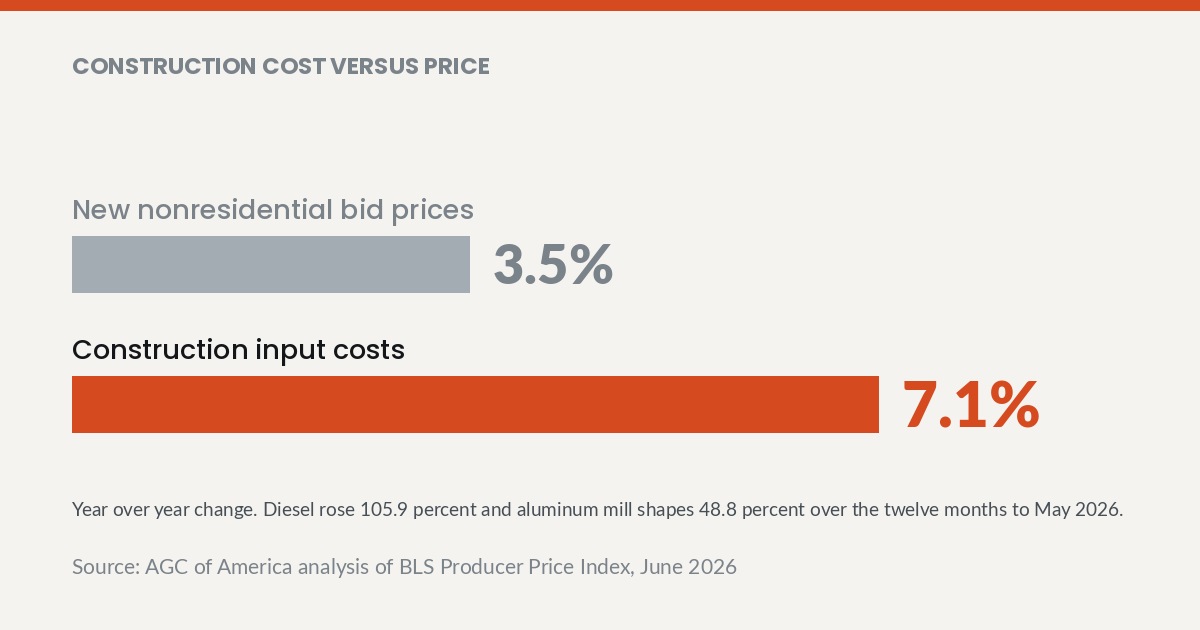
Construction financial management turns on one measurable spread, the difference between input cost inflation and bid price inflation. AGC of America's June 2026 analysis of BLS producer price data puts construction input costs up 7.1 percent against new nonresidential bid prices at 3.5 percent. That gap is margin leaving the business every month it persists.
The spread is the mechanism, not the price level
Most contractors watch input prices in absolute terms and react to the headline movers. That framing produces frustration and very little in the way of a decision. The number that changes behavior is the spread between what inputs cost and what the market will pay.
AGC of America's analysis of BLS Producer Price Index data for June 2026 shows construction input costs up 7.1 percent year over year. The new nonresidential bid price index rose 3.5 percent over the same window. AGC's May 2026 reading put input inflation at 8.4 percent against the same 3.5 percent bid price figure. That was the largest year over year input jump since the pandemic.
Two consecutive months at more than double the rate is not volatility. It is a persistent condition that estimating assumptions built in a calmer period will not absorb. A contractor bidding fixed price work on last year's escalation assumption is signing up for a loss it will discover at closeout.
The spread never appears as a line item on a profit and loss statement. It appears as a portfolio of jobs that were estimated at one margin and delivered at another. By the time the pattern is visible in year end results, the backlog that will repeat it has already been signed.
The inputs moving fastest are the ones least visible in a bid
Aggregate indexes hide the distribution of pressure across trades and material categories. AGC's analysis of BLS producer price data covering the twelve months to May 2026 breaks the movement out by component.
- Diesel at 105.9 percent
- Aluminum mill shapes at 48.8 percent
- Copper and brass at 26.8 percent
- Truck freight at 17.3 percent
- Fabricated structural steel at 15.6 percent
No contractor carries all of those exposures in the same proportion. A sitework contractor lives and dies on diesel and equipment hours. An electrical subcontractor is exposed to copper before anything else. A steel erector carries both fabricated steel and the freight cost of moving it to site.
Diesel and truck freight deserve separate attention because they hide inside other line items. They sit in general conditions, in equipment operating cost and in the delivered price of every material that arrives on a truck. A blended escalation assumption applied across a whole bid misprices the trades carrying the heaviest exposure.
The practical consequence is that a single company-wide contingency percentage is the wrong instrument. Exposure varies by scope, by material package and by how much of the work is self-performed. Estimating departments that carry one number for all of it are averaging away the information that matters.
A shrinking market removes the easy answer
The obvious response to input inflation is to raise bid prices. Market conditions are not cooperating with that answer. Census C30 data for May 2026 puts total construction spending at $2,210.2 billion at a seasonally adjusted annual rate, down 1.5 percent against May 2025.
January through May 2026 ran 2.7 percent below the same period in 2025 on that same Census series. Fewer projects with more bidders per project does not produce pricing power. It produces the opposite, at exactly the moment input costs demand relief.
The bid-hit ratio becomes the diagnostic in this market. A contractor whose hit rate improves while volume stays flat is not winning on capability. It is winning because its numbers are lower than they should be, and the shortfall surfaces at closeout rather than at award.
Backlog quality deserves the same scrutiny as backlog volume. A growing backlog priced against stale escalation assumptions is a liability disguised as a leading indicator. Firms that report backlog in dollars without reporting the estimated margin behind it are measuring the wrong half of the number.
Why the gap compounds instead of averaging out
A single quarter of adverse spread is absorbable. The problem is structural persistence, because construction contracts convert a moment of pricing into months of delivery. Work bid under one cost assumption gets built under another, and the longer the backlog, the longer the lag.
That lag is why the gap compounds rather than averaging out. A firm carrying a year of backlog priced at 3.5 percent bid inflation is building that work while inputs move at 7.1 percent. That is the AGC reading of BLS producer price data for June 2026. Every month of duration widens the difference between the estimate and the invoice.
Repeat work for the same owner makes the compounding worse. Contractors that hold pricing steady for a favored owner across successive awards are extending a subsidy that grows with each renewal. The relationship feels stable right up to the point where the account becomes the least profitable in the portfolio.
The compounding is also asymmetric across the organization. Overhead and general conditions rise under the same input pressure, while the recovery mechanism sits only in direct cost pricing. Firms that escalate direct costs but hold general conditions flat recover part of an increase they are paying in full.
Labor scarcity closes the productivity escape route
Margin compression has a traditional answer, which is to build the same work with fewer hours. The labor market is not offering that option. The AGC of America and NCCER Workforce Survey for 2025 found 92 percent of firms with craft openings report difficulty filling them.
That survey drew 1,342 responses, 57 percent of them from firms under $50 million in revenue and 62 percent open shop. The respondent base looks like the mid-market contractor rather than the national builder. Scarcity at that scale is priced into subcontractor quotes long before it appears in any wage report.
The structure of the trade base explains part of the problem. BLS Current Employment Statistics for April 2026 put construction employment at 8,321,000 with specialty trade employment at 5,249,000. BLS QCEW counted 599,074 specialty trade contractor establishments in the fourth quarter of 2025.
That establishment count against that headcount describes a supply base of very small firms. Fragmentation makes the subcontractor base unstable under sustained cost pressure. BLS Business Employment Dynamics for the third quarter of 2025 recorded construction establishment gross job losses of 678,000 against gains of 623,000. That was the second straight quarter in which losses exceeded gains.
A general contractor that fixes its price before locking subcontractor pricing carries the labor premium on its own balance sheet. The subcontractor quote will move between bid and buyout. The prime contract will not move with it.
What a contractor should be measuring monthly
Nothing in this picture requires proprietary data. The producer price index series, the Census spending series and the workforce surveys are all published on a public cadence. What separates contractors who manage the spread from contractors who discover it is whether anyone reads them monthly.
The discipline is a reporting cadence rather than an analytical breakthrough. A one page monthly review covering the input index, realized bid prices, backlog margin and the bid-hit ratio is enough. Contractors that put that page in front of ownership every month behave differently from contractors that review pricing once a year.
Escalation clauses tied to a named index
An escalation clause that references market conditions in general terms is unenforceable in practice. A clause naming a specific producer price index series, a baseline date and a trigger threshold gives both parties something to compute. Owners resist the concept less than contractors expect once the mechanism is specific and symmetrical.
Contingency held separately from margin
Contingency folded into margin disappears the first time a project manager needs a favor. Held as a separate line with a documented release process, it functions as the risk instrument it was priced to be. Contractors that blur the two cannot tell a cost overrun from a pricing error.
Unit cost feedback from closed jobs
Estimating improves only when closed job actuals return to the estimating team at unit cost level. Most contractors close a job, book the variance and move to the next award. The estimate that produced the variance stays in the library unchanged, ready to produce the same variance again.
Change orders priced at current cost
Change orders are the one pricing event that happens at current cost rather than bid-date cost. Contractors that price change orders off the original bid basis give away the only inflation-adjusted revenue on the job. Firms that treat change order pricing as a discipline rather than an afterthought recover a real share of the spread.
Material procurement timing belongs in the same category of controllable decisions. Firms that lock steel and copper pricing at award rather than at fabrication release remove a large share of exposure without touching the bid number. Operators who want outside help building that discipline are usually better served by a management consulting engagement focused on operating and financial process than by another software purchase.
The contractors still operating on healthy margins two years from now will not be the ones who guessed right on steel. They will be the ones who made the spread a standing agenda item and priced against it deliberately. Input inflation is an external condition that no contractor controls. Whether a firm carries that condition or passes it along is an internal decision, made every time an estimate leaves the building.
Frequently Asked Questions
How do I know whether input inflation is actually hurting my margin?
The test is a comparison of margin estimated at bid against margin realized at closeout across completed jobs. A widening negative spread appearing across multiple project managers and multiple job types points to a pricing problem rather than an execution problem. Contractors reviewing gross margin only at the company level cannot see this pattern. The signal lives at the job level and has to be read there.
Should my firm add escalation clauses to every contract?
Escalation clauses belong on any fixed price contract with a duration long enough for input costs to move materially. Short duration work priced and built inside a single quarter carries less exposure and less need for the mechanism. The clause should name a specific published index, a baseline date and a trigger threshold. Vague language about market conditions gives a contractor no enforceable position when costs move.
What is a healthy bid-hit ratio in this market?
The number itself matters less than its direction relative to volume and realized margin. A hit rate climbing while revenue stays flat and margin falls indicates underpricing rather than improved competitiveness. Contractors should review the ratio by trade and by owner type rather than in aggregate. A single blended figure hides the exact segments where pricing has gone wrong.
How should the labor shortage change the way subcontractor pricing is handled?
Subcontractor quotes carry the scarcity premium well before it reaches published wage data. The AGC of America and NCCER Workforce Survey for 2025 found 92 percent of firms with craft openings report difficulty filling them. A prime contractor that fixes its price before buying out its subcontractors absorbs whatever moves between bid and buyout. Shortening that window is the most direct control available to a general contractor.
Is contingency the right tool for input cost risk?
Contingency covers uncertainty in scope and execution rather than directional cost inflation. Using it to absorb a known and measurable input trend consumes the buffer before the project meets its real surprises. Escalation clauses, procurement timing and explicit cost allowances handle inflation more precisely. Contingency should stay available for the risks it was actually priced to cover.
Where should a contractor start if none of this is currently tracked?
The first step is a monthly comparison of the input cost index against the firm's own realized bid prices. That single chart, maintained across a few quarters, reveals whether the firm is passing cost along or absorbing it. Closed job unit costs should then flow back to estimating on a fixed schedule rather than on request. Neither step requires new software, only a named owner and a recurring calendar slot.
No comments:
Post a Comment
Note: Only a member of this blog may post a comment.