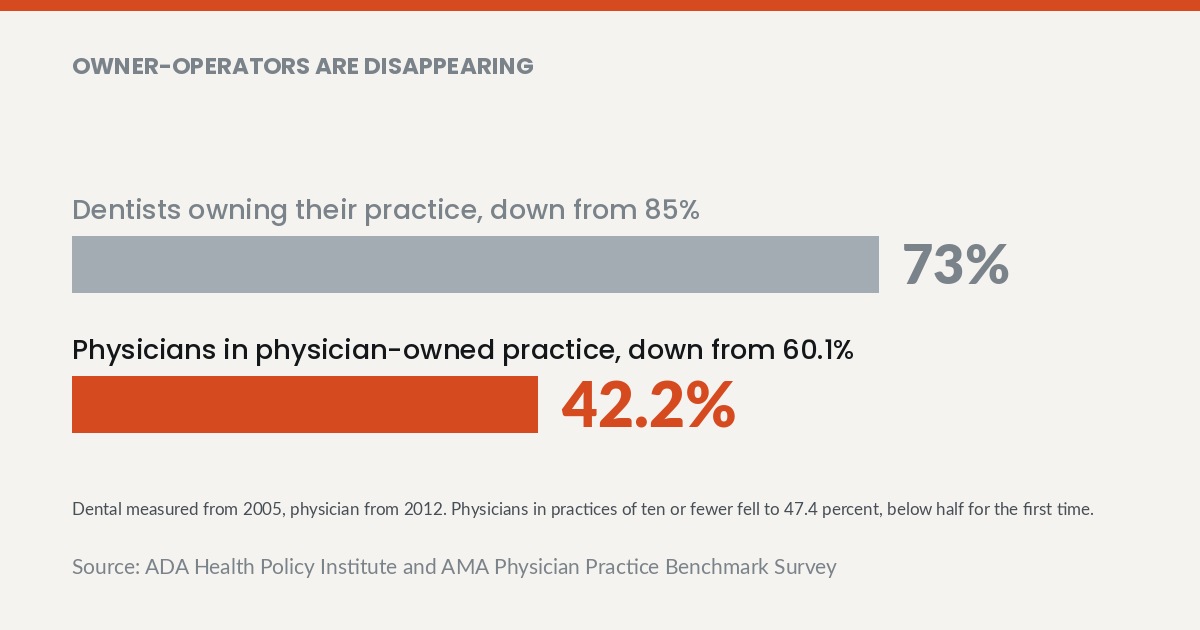
A fractional COO supplies senior operating leadership part-time to companies too small to employ one full-time. Demand for that role is concentrated where owner-operators are exiting. Physicians in wholly physician-owned practices fell to 42.2 percent from 60.1 percent in 2012, according to the American Medical Association. Acquirers bring a management layer. Independents have to build one.
The same curve in five industries at once
Consolidation stories are normally told one profession at a time. Dental gets a trade press narrative about dental service organizations. Medicine gets a policy debate about hospital employment. Law gets a merger tally. Each account treats its own industry as the special case.
The data does not support that framing. Ownership is contracting on similar timelines in dental, medical, legal, automotive and construction, and the reporting bodies have no connection to each other. Five separate measurement systems are describing the same movement.
Dental
The ADA Health Policy Institute reports that dental practice ownership fell from 85 percent in 2005 to 73 percent. Affiliation moved in the other direction over a much shorter window. DSO affiliation doubled from 7.2 percent in 2015 to 16.1 percent of all dentists as of 2024.
The generational split is the sharper figure. ADA HPI found that 31 percent of dentists fewer than five years out of school are DSO affiliated. The population that would normally buy retiring owners out is choosing employment instead.
Medicine
The AMA Physician Practice Benchmark Survey for 2024, based on 5,000 physicians with a 43 percent response rate, tracks the same slope. Physicians in wholly physician-owned practices fell to 42.2 percent from 60.1 percent in 2012. Physicians holding an ownership stake fell to 35.4 percent from 53.2 percent.
Scale moved with ownership. Physicians in practices of ten or fewer fell to 47.4 percent, below half for the first time, from 61.4 percent in 2012. Solo practice fell to 11.9 percent from 18.4 percent over the same period.
Law, automotive and construction
Legal consolidation now happens at the small end. Fairfax Associates reported for 2025 that 76 percent of law firm mergers involved a firm of five to twenty lawyers, up from 69 percent in each of the prior two years. The activity is no longer about large firms combining.
Automotive shows the same compression among small owners. NADA Data for 2025 puts dealership owners operating one to five stores at 90.5 percent, down from 94.4 percent in 2016. Group ownership is absorbing single-point and small-group operators.
Construction lacks a comparable published series, which is why it is usually left out of these discussions. The pattern in specialty trade contracting is nonetheless familiar to anyone working in the sector. Aging owners, no internal successor with the capital to buy, and acquirers assembling regional platforms out of mechanical, electrical and roofing firms.
What makes the grouping notable is the independence of the measurements. Dentists are counted by a dental association, physicians by a medical association, lawyers by a legal consultancy and dealers by a trade body. No shared methodology or definition connects them.
What acquirers are actually buying
The obvious explanation is that owners are tired and buyers have capital. That is true and insufficient. Sellers are explicit about what they get in exchange, and the top answer is not relief.
The AMA found that 70.8 percent of practices that sold cited the ability to negotiate higher payment rates as a reason. Payer negotiating position is a function of size. An owner-operator cannot manufacture it internally at any level of effort.
Private equity participation is more recent than the headlines imply. The AMA reports 6.5 percent of physicians in private equity owned practices, up from roughly 4.5 percent in both 2020 and 2022. The recency shows in the acquisition dates, with 38.3 percent of private equity owned practices acquired after 2019 against 10.0 percent of hospital-owned practices.
A platform acquisition followed by add-on transactions is the standard structure. The buyer purchases one anchor firm, installs a management services organization, then acquires smaller practices that plug into the shared back office. The valuation multiple paid on the platform exceeds what add-ons receive, which is why the earnout terms differ so sharply between the two.
The cause is not industry specific
Nothing about dental economics resembles dealership economics. Payer mix, capital intensity, licensing and customer behavior have almost nothing in common across these five sectors. A common outcome across uncommon industries points to a cause that sits above all of them.
That cause is the collapse of the owner-operator management model. In a small professional firm, the owner is the entire management layer. The same person handles billing oversight, hiring, vendor contracts, compliance, marketing, technology decisions and scheduling, on top of practicing the profession.
The administrative content of that job has grown steadily. Payer requirements, employment regulation, cybersecurity obligations, software stacks and consumer expectations all expanded. The number of hours an owner can work did not.
Succession compounds the squeeze. When the next generation prefers employment, as the dental affiliation figures for early-career dentists show, the internal buyer disappears. An owner who cannot sell inside the firm sells outside it, and the outside buyer is a consolidator.
The management layer is the transferable part
Look closely at what an acquirer installs after closing and the list is unremarkable. Centralized revenue cycle and billing. Payer or vendor contract negotiation handled by specialists. Standardized hiring, onboarding and compensation structures. Group purchasing. Shared marketing. Compliance and reporting run once for many locations.
None of that is clinical, legal or technical work. It is operations. The professional service delivered to the customer is frequently unchanged after an acquisition, and in many cases it is delivered by the same people in the same building.
The acquirer is monetizing the gap between what a small firm produces and what professional management would let it produce. Spreading fixed administrative cost across more locations is real scale economics. Better contract terms, better purchasing and lower cost per transaction are the returns.
Capital access is the second half of the equation and it is genuinely one-sided. Consolidators fund equipment, technology and location expansion from a balance sheet an individual owner cannot match. That advantage is real, though it applies to growth ambition rather than to daily operating performance.
That framing produces an uncomfortable question for owners who do not want to sell. If most of the value created by consolidation comes from a management layer rather than from the transaction itself, the layer is separable from the sale.
Building the layer without selling the firm
A firm that keeps its independence still has to answer the operating problem that made selling attractive. The answer is a management capability the owner does not personally supply. Full-time senior operations hires are usually unaffordable and frequently underemployed at small-firm scale.
Part-time senior leadership is the direct substitute. Owners in this position often engage a fractional COO to install the systems an acquirer would install, then step back to a lighter cadence once the operating rhythm holds. The work is sequencing, measurement and role definition rather than a permanent seat.
Structural options exist alongside the leadership question. Independent practice associations, clinically integrated networks and management services organizations formed among independents provide shared services without an equity sale. Group purchasing arrangements deliver a portion of the cost benefit that a roll-up captures.
None of these fully replicate the rate negotiation advantage that 70.8 percent of selling practices cited. Honest advice acknowledges that. Scale genuinely produces contract terms that independents cannot match, and no operating improvement closes that particular gap entirely.
What operating improvement does close is everything else. Cost per transaction, staff productivity, cash collection speed and owner time are all controllable at any size. A firm that fixes those items has narrowed the gap to the single component that requires scale.
When selling is the correct decision
Consolidation is not a failure state and treating it as one produces bad decisions. An owner within a few years of retirement, without an internal successor and without appetite for a multi-year operational rebuild, should probably sell. Perpetuation planning that starts too late leaves no other option worth taking.
The decision worth scrutinizing is the one made by an owner with a decade or more of working life remaining. Selling to escape administrative burden trades a permanent ownership position for temporary relief. The administrative burden was solvable. The ownership stake is not recoverable.
Owners choosing that path deserve a clear accounting of what they are exchanging. Independence has an operational price and the price is a management layer. Firms that pay it directly keep the equity.
The sequencing matters as much as the decision. A firm with documented processes, clean reporting and a functioning management structure negotiates from strength if it later chooses to sell. Building the layer improves both outcomes rather than committing the owner to only one of them.
Five industries with nothing in common are losing owner-operators at the same time, and the shared explanation is that running a small firm now requires management capacity the owner cannot personally supply. Acquirers noticed first and built a business model around it. The response available to independents is the same capability on different terms, and the firms that build it will find they were never actually choosing between selling and struggling.
Frequently Asked Questions
What does a fractional COO actually do in a small professional firm?
The role installs the operating systems that an owner has been running informally. That typically covers revenue cycle oversight, hiring and onboarding structure, vendor and contract management, reporting cadence and clear role definitions across the team. The engagement is defined by scope and outcome rather than by hours in a chair. Most arrangements taper as internal staff take ownership of the systems that were built.
Is consolidation actually accelerating or is this normal industry cycling?
Independent sources across unrelated industries point the same direction. The ADA Health Policy Institute records dental practice ownership falling from 85 percent in 2005 to 73 percent, and the AMA records physicians in wholly physician-owned practices falling to 42.2 percent from 60.1 percent in 2012. NADA Data for 2025 shows dealership owners operating one to five stores dropping to 90.5 percent from 94.4 percent in 2016. Cyclical movement does not usually align this closely across sectors with unrelated economics.
Should my firm sell now or build management capability?
Time horizon is the deciding variable. An owner near retirement with no internal successor gains little from a multi-year operational rebuild and should evaluate offers seriously. An owner with a long runway is trading a permanent asset for relief that a management layer would also deliver. The comparison worth running is the cost of that capability against the value of the ownership stake being surrendered.
Why do practices say they sold if they were not in financial trouble?
Distress is not the leading motive in the survey data. The AMA found 70.8 percent of practices that sold cited the ability to negotiate higher payment rates as a reason. Contracting position scales with size in ways that operational excellence alone does not overcome. Owners frequently sell from a position of stability because the ceiling on independent negotiating position is structural.
Can independents get scale benefits without giving up equity?
Partially, and the qualifier matters. Independent practice associations, clinically integrated networks, group purchasing arrangements and independent-owned management services organizations deliver shared administrative cost and some purchasing advantage. These structures do not fully match the payer contracting position of a large consolidated platform. Firms should pursue them for cost and capability while being realistic about the rate ceiling.
How does this affect younger professionals entering the field?
Entry patterns have already shifted toward employment. The ADA Health Policy Institute found in 2024 that 31 percent of dentists fewer than five years out of school are DSO affiliated. That removes the traditional buyer for retiring owners and accelerates outside acquisition. Firms wanting an internal succession path need to make ownership attractive well before the owner is ready to exit.
No comments:
Post a Comment
Note: Only a member of this blog may post a comment.