Business process improvement fails less often from bad design than from absent ownership. A documented process without a named owner decays the moment conditions change. Durable improvement needs one person accountable for each handoff, a measure that person watches, and authority to change the step. Documentation only records a decision, while ownership is what keeps that decision true.
Most mid-market operations already hold plenty of process documentation. Binders, wiki pages, flowcharts and onboarding decks exist in volume. What they lack is a named human who notices when daily reality drifts away from the written version.
That gap explains why the same improvement gets funded twice inside a few years. The map was never wrong to begin with. The map simply stopped matching the territory, and nobody carried responsibility for saying so out loud.
Efficiency Gains Decay Because Nobody Inherits Them
An improvement project follows a familiar arc. Somebody notices waste, a team forms, changes get made, and results show up inside a quarter. Then the team disbands and the process returns to whoever was doing the work before.
The returning operator inherits the steps but never the reasoning behind them. When an exception arrives, and exceptions always arrive, that operator has no basis for judging which rule actually matters. So the rule gets bent once, then routinely, and the old cost structure quietly reassembles itself. This is the mechanism behind the pattern where an efficiency push fades and the waste comes back without anyone announcing a reversal.
Imported frameworks fail along exactly the same path as internal projects. A methodology borrowed from a book or a former employer describes an end state, not the sequence of Monday decisions that produce it. Teams adopt the vocabulary, skip the operating discipline, and then conclude the framework does not work in their business.
The more accurate reading is that a framework collapses on contact with Monday morning whenever no one owns the first step. Ownership is not supervision, and an owner does not spend the day watching people work. A real owner holds a specific outcome, sees the number that describes it, and can change the process without asking three other functions for permission.
The distinction matters most when responsibility gets assigned on paper. Naming a steering group, a committee or a function does not create an owner. Ownership requires a single person whose performance review reflects whether the process still holds. Anything shared across several people reverts to nobody within a quarter or two.
Mapping Reveals Who Actually Holds Each Step
Process mapping gets treated as a documentation exercise. Done properly, mapping is an ownership audit rather than a drawing exercise. Every arrow between two boxes is a transfer of responsibility, and most operational failure lives on those arrows rather than inside the boxes.
Teams that walk a process physically, following one order or one ticket from intake through to cash, find the same things repeatedly. Steps drawn on the chart do not happen. Steps that happen every day were never drawn at all. Approvals exist that no policy requires, added years ago by someone who has since left.
The discipline of mapping a process to expose where the work actually moves converts vague frustration into a specific list of unowned transfers. That list of transfers is the real deliverable of the exercise. The chart itself is only the packaging around it.
Mapping produces a second benefit that gets overlooked. It gives an operation shared vocabulary for waste, which is the precondition for measuring waste at all. Without shared terms, one manager calls a delay a capacity problem while another calls it a priority problem, and the argument never resolves.
Naming waste precisely is what turns operational efficiency into something measurable rather than aspirational. Rework, waiting, duplicate data entry and unnecessary approval each carry a different fix. Treating them as one undifferentiated problem produces one undifferentiated cost-cutting exercise. That is how efficiency work earned its bad reputation with operators.
A map also fixes review cadence, which is where most improvement programmes quietly stop. Someone has to examine the process on a schedule and compare it against the written record. Monthly review suits stable operations and weekly review suits periods of change. What does not work is examining a process only after it fails visibly.
The Weakest Link Is Invisible From Inside
Owners and long-tenured executives cannot see their own worst handoff. Familiarity converts workarounds into scenery that nobody registers any more. A step that consumes hours every week stops registering as a step once the team has absorbed it into normal effort.
The blindness is structural rather than personal or a matter of attention. Anyone who designed a system evaluates it against the intent behind it, not against what a new hire experiences on day one. The reason nobody can spot the weakest link in an operation they built themselves is that the weak link usually holds up something else they value.
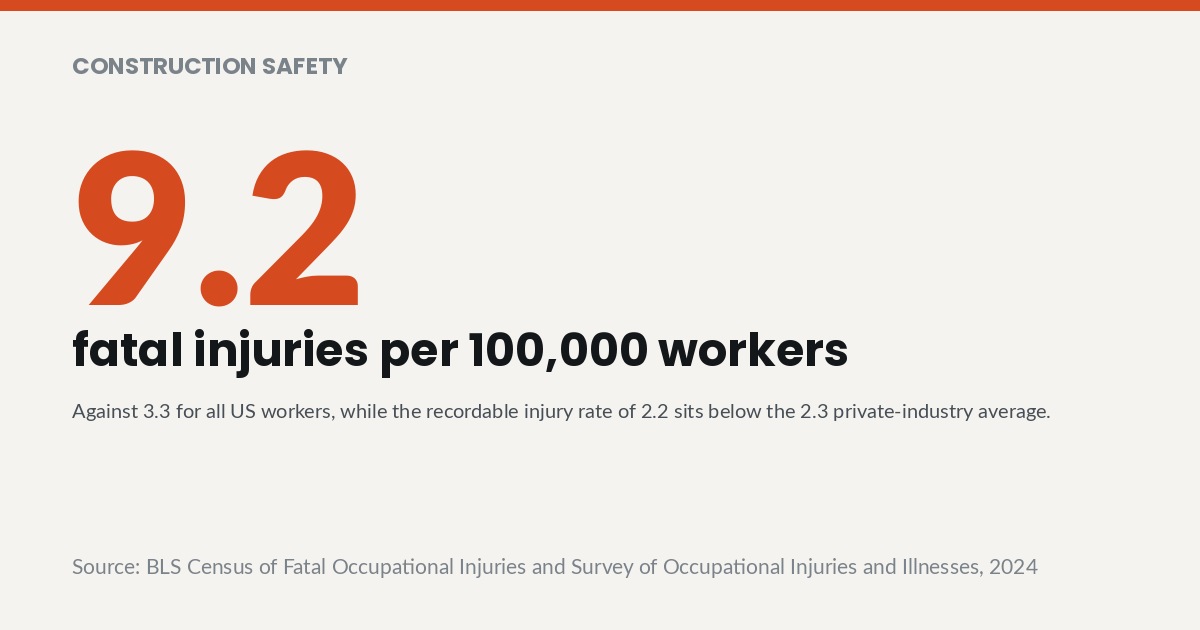
Construction work shows the pattern in unusually hard numbers. The construction recordable injury rate is 2.2 per 100 full-time equivalents, below the 2.3 all private industry average. Its fatal injury rate is 9.2 per 100,000 against 3.3 for all US workers. Those figures come from the BLS Survey of Occupational Injuries and Illnesses and the Census of Fatal Occupational Injuries for 2024.
Read together, those two measures describe an industry that manages routine risk about as well as anyone and catastrophic risk far worse. Routine hazards are owned by someone specific on every site. They get inspected daily, tracked by named supervisors, and priced into every bid. Severe outcomes cluster where responsibility transfers between trades, shifts and subcontractors, which is precisely where no single party holds the result.
Ordinary process failure follows the same geometry with money rather than lives as the cost. Steps that sit inside one function stay reasonably healthy because someone is judged on them. The damage concentrates at the seams, and the seams belong to nobody by default.
Broken Workflows Get Diagnosed as Bad People
When output drops, the first explanation offered is usually effort. Managers reach for engagement surveys, accountability language and performance plans. The evidence inside the workflow rarely supports that reading.
Capable people inside a broken process produce the same visible symptoms as unmotivated people. Missed dates, defensive status updates and obvious fatigue all appear. The difference is that hard work disappears into workflows never designed to carry it, so effort climbs while output stays flat. Performance management applied to a structural problem burns the exact people who were compensating for it.
The senior version of this failure is worse because it looks like diligence. An owner who reviews every quote, approves every discount and signs off on every hire believes the involvement protects quality. What it actually does is convert one calendar into the throughput limit for an entire company.
Being the bottleneck that every decision waits on is a process defect wearing an org chart. The fix is not delegation framed as a personality change. The fix is a written decision rule, a stated spending threshold, and a named person who owns every outcome below it.
Both failures trace back to a single root cause. Neither the frustrated operator nor the overloaded owner holds authority matched to the responsibility they carry. Assigning people accountability without the power to change the steps around them guarantees the behaviour that gets criticised later.
Revenue Handoffs Break First and Cost the Most
Process work usually starts in fulfilment, service or finance. Those areas are easier to observe because their failures leave physical evidence. The most expensive unowned handoffs sit between marketing, sales and delivery, where a dropped transfer costs a deal instead of producing a visible defect.
The symptoms are familiar to anyone who has watched a pipeline closely. A lead arrives and then waits for somebody to claim it. A quote goes out without the delivery team ever seeing it. A promise made during the sale reaches operations only after the contract is signed.
Each of those is a handoff without an owner, and each surfaces later as margin erosion nobody can trace to a cause. Treating the sales operation as a managed function rather than a collection of personal habits is what closes the gaps. Definitions, entry criteria and named stage owners do more for conversion than another round of training.
Growth amplifies every one of the defects described so far. Adding volume to an operation full of unowned handoffs does not scale the business, it scales the failure rate. Headcount then gets hired to absorb the friction, which raises fixed cost while concealing the original defect for another year.
That is why sustainable scaling depends on process ownership rather than added capacity. Companies that survive fast growth are not the ones with the best documentation. They are the ones where every transfer of work carries a name.
Fixing revenue handoffs rarely requires new software at all. It requires a written definition of what a qualified opportunity contains, a rule for who touches it next, and a standard for how quickly that happens. Most operations already own tools capable of enforcing all three. What they lack is agreement about the definitions themselves.
Process work gets sold as a documentation problem and priced as a software problem. A process improves when one person is accountable for an outcome, watches a number that moves when the work moves, and holds permission to change the steps. Everything else is a record of a decision somebody once made. The handoff, not the document, is where an operation actually lives.
Frequently Asked Questions
How can you tell whether a process has a real owner?
Ask who changed it last and why. A process with a genuine owner has a change history and a person who can explain the reasoning without looking anything up. If the answer is a department name rather than a person, the process is unowned. Shared ownership across a function behaves the same way as no ownership at all.
Where should business process improvement start?
Start where work crosses a boundary between teams, systems or shifts. Those transfers hold most of the delay and nearly all of the untraceable cost. Walking one real unit of work from request through to payment surfaces more useful detail than a workshop. The output should be a list of transfers with a name assigned to each.
Why do efficiency gains fade after the project ends?
The project team carries the reasoning behind each change, and that reasoning leaves when the team disbands. The operator who inherits the steps has no basis for handling exceptions, so exceptions get handled by improvisation. Improvisation becomes habit, and habit restores the old cost structure. Assigning a permanent owner before the project closes prevents the reversal.
Is process improvement worth doing in a smaller company?
Smaller companies gain more, not less, because fewer people absorb each defect. A single unowned handoff in a lean team consumes a meaningful share of total capacity. The work also costs less at small scale, since fewer systems and approvals need changing. Waiting until the company is large converts a cheap fix into an expensive one.
How do you stop being the decision bottleneck?
Write down the decisions currently requiring approval and sort them by value and risk. Set a threshold below which a named person decides without escalation, and publish it. Review the decisions made under that threshold on a fixed cadence rather than in the moment. The goal is a rule that survives whoever happens to be in the room.
What proves that a process actually improved?
One measure owned by one person, tracked before and after, moving in the intended direction. Cycle time, rework rate and touch count usually reveal more than cost per unit, because cost hides the cause. The measure must be visible to the person who can change the process. A number nobody owns describes history rather than performance.
No comments:
Post a Comment
Note: Only a member of this blog may post a comment.