Business strategy consulting earns its fee at the handoff, not the offsite. A useful engagement leaves behind named owners, dated decisions and a measurement rule for each one. Plans fail because nobody holds the decision on Monday morning. The work below sorts the recurring failures into planning, positioning, measurement and technology, and shows where ownership goes missing.
The Handoff Is Where Strategy Dies
Most mid-market strategy work is analytically sound and operationally orphaned. The document names a direction without naming the person accountable for the first move. Ownership is the difference between a decision and a preference.
The pattern starts long before anyone drafts a strategic plan. Firms commission market studies, read them once and shelve them, which is the failure behind buying research and never converting it into a decision. The same reflex governs advisory relationships, where owners purchase an outside view and then decline every recommendation that costs them a habit.
Two separate forces combine to produce the orphaned decision. The first is a calendar that treats strategy as an event rather than a standing agenda item. The second is a compensation structure that rewards activity and stays quiet about outcomes.
Owner capacity is the constraint that never appears on the plan. The person best positioned to grow the business holds the least unscheduled time, a trap examined in why the strongest growth asset in a firm has no hours left. A plan that assumes founder availability assumes a resource already spent.
Choosing a delivery model matters more than choosing a framework. The differences between advisory, interim and embedded engagements appear in a comparison of consulting engagement models, and they determine who carries the decision afterward. Growth stage sets the same boundary, because controls that fit a founder-led shop break at the next stage of small business growth.
Handoff quality can be measured without a survey. Count the decisions from the last planning cycle that carry a name, a date and a stated trigger for review. The count is usually small, and it predicts the next cycle with uncomfortable accuracy.
A blunt test applies to any strategic recommendation. Name the person who loses something if the recommendation is ignored. When that name does not exist, the recommendation is commentary rather than strategy.
Planning For Conditions Nobody Controls
Strategy built on stable input costs is close to arithmetic. Strategy under moving inputs is a different discipline, and most mid-market plans never make the switch. That distance is the subject of the gap between a downturn already underway and a plan written for calmer conditions.
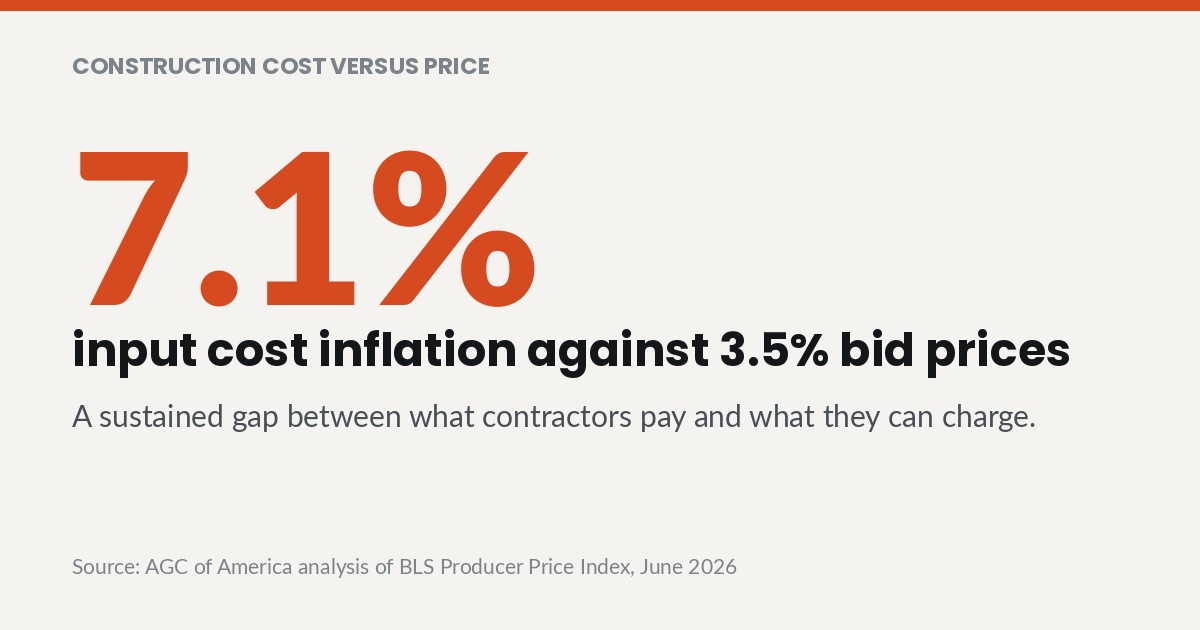
Construction gives the clearest reading of the problem. Input costs rose 7.1 percent year over year while new nonresidential bid prices rose 3.5 percent. That reading comes from AGC of America analysis of the BLS Producer Price Index in June 2026. A plan built on an older spread between cost and price is already wrong.
Insurance behaves the same way for operators far outside construction. Commercial auto premiums have risen for 59 consecutive quarters since the third quarter of 2011, according to the CIAB Commercial Property and Casualty Market Index. A line item that climbs for that long is not a shock. It is a planning assumption that most budgets still refuse to make.
Scenario work fails in mid-market firms for a simple reason. Scenarios get written and never wired to a trigger, so nobody knows which one is running. A scenario without a trigger is a mood rather than a plan.
Contraction exposes what was never built during good years. Owners who deferred people systems discover the cost when headcount must fall, a risk traced in why a downturn breaks employers who never built an HR function. Cash pressure does the same to the operating model, which is the subject of what to change when reserves shrink and the old playbook stops working.
Two further planning failures repeat across almost every sector. Capital equipment timelines set the ceiling on responsiveness, a constraint examined in the competitive cost of long hardware lead times. Remedies carrying enterprise price tags stay unusable below a certain revenue line, which is the argument in why enterprise-scale fixes do not scale down.
Revenue planning fails in exactly the same shape. Qualifying for work is not the same as winning it. The distance between the two appears in meeting every requirement on a bid and still losing the award, and that distance is where most bid strategy collapses.
Fixed-price commitments deserve a second look whenever input costs move. Contracts written across long horizons transfer volatility to whichever party lacks an escalation clause. That party is almost always the smaller of the two.
Position And Price Are Strategy Decisions
Price is the fastest move available and the least defensible one. Undercutting works only when the buyer sees two genuinely identical options. That condition is rare, and it grows rarer as service models diverge.
Most losses attributed to price are losses of clarity. The pattern appears in cutting below rival pricing and still losing the deal. Buyers cannot separate claims arriving through paid channels from claims arriving through earned ones, a confusion covered in why customers cannot tell public relations from advertising.
Differentiation is an operational claim before it becomes a marketing claim. Sales teams cannot defend a difference the delivery organization does not actually produce. Price pressure is the market reporting that the difference stays invisible.
Valuation asymmetry is the same problem wearing different clothes. An asset worth almost nothing to its holder can be worth a great deal to a buyer with a use for it. That gap drives the lesson in how one domain carries wildly different value to seller and buyer. Positioning is the work of finding the party for whom the asset is expensive.
Service expectations move without asking permission from any supplier. Buyers compare response times against their best recent experience rather than against sector norms. That trap is described in serving current expectations with a service model designed years ago.
Position is therefore a delivery decision made visible to the market. A positioning statement that ignores the comparison buyers actually run is decoration. The claim has to survive the first support ticket.
Measurement That Ends In A Decision
A metric that cannot change a decision is overhead. Dashboards grow by accretion, because adding a number is easier than retiring one. The result is a wall of indicators and no obvious next action.
That failure is the subject of tracking a hundred indicators and still being unable to decide. The remedy is not fewer numbers for their own sake. The remedy is attaching every measure to a named owner and a threshold that triggers action.
Objectives frameworks exist to enforce exactly that link. Returns depend entirely on implementation quality, which is the case made in what proper implementation of objectives and key results actually returns. Installed badly, the same framework becomes another reporting tax on the operating team.
Reporting cadence deserves the same scrutiny as reporting content. Numbers reviewed monthly cannot govern decisions made hourly on the floor. Matching review rhythm to decision rhythm removes more confusion than adding another chart.
Measurement also decides whether problems get solved or quietly absorbed. Teams patch recurring faults without ever naming them, a habit described in bandaging problems the team refuses to acknowledge. The discipline that reverses it is structured root cause analysis, which forces the question of why the fault survived the process.
Detection timing is the quiet indicator inside any quality system. When a defect reaches the client before it reaches an internal report, the measurement system is decorative. That failure appears in learning about a defect from the client rather than from the line.
Quality data arriving after the customer complaint carries no decision value. The useful question is how early the organization can see a fault. Everything downstream of that answer is apology management.
Tools Own Nothing And Change Nothing
Software purchases are strategy decisions disguised as procurement events. The license changes nothing until someone changes how the work is sequenced. Adoption is a management act rather than an information technology deliverable.
The gap between purchase and behavior appears in buying the software and seeing no operational difference. Artificial intelligence repeats the same failure with a new surface. The model retains what it receives, while the company loses context between sessions, a mismatch examined in the context that disappears between one assistant session and the next.
Every tool decision creates a second decision that rarely gets made. Someone must retire the process the tool replaced, including the spreadsheet that quietly survives. Parallel systems are the most common reason a rollout produces no measurable change.
Project delivery shows the same confusion between tooling and ownership. Late and over budget is rarely a tool problem, though the delivery system matters, as set out in picking a project system after schedule and budget have both slipped. Coordinating related projects needs a different structure entirely, which is the case for running linked initiatives as a managed program.
Vendor selection absorbs attention that belongs to change design. The purchase consumes a week of work, while adoption consumes a quarter of management attention. Very few budgets reflect that ratio in any way.
Every failure described above shares a single shape. A decision was made, communicated and then left without an owner. The organization reverted to the behavior that existed before the announcement. Strategy consulting that stops at the recommendation has delivered half the work, and the half that matters starts when the room empties.
Frequently Asked Questions
What does business strategy consulting actually deliver?
A strategy engagement should deliver decisions with owners attached rather than a document. The useful output names what changes, who is accountable and what evidence would reverse the call. Analysis is the cheap part of the work. Installation of ownership determines whether anything moves at all.
How do you know your strategy failed at execution rather than at design?
Design failures show up as the wrong direction, while execution failures show up as no direction taken. If the plan still reads as correct months later and nothing shifted, the failure sits at the handoff. Check whether each decision carried a named owner and a review date. The absence of both explains most stalled plans.
When should a mid-market company hire outside strategy help?
Outside help earns its cost when the decision is unfamiliar and delay is expensive. Recurring decisions belong inside the company and should stay there. One-time structural calls, such as entering a new segment or rebuilding a delivery model, benefit from an operator who has run that sequence before. The test is frequency rather than company size.
Why do so many strategic plans die after the offsite?
The offsite produces alignment, and alignment decays without a standing forum. Nobody carries the decision into the operating calendar, so the previous priorities reclaim the week. Plans survive when each decision joins an existing meeting with an owner who reports on it. Without that, the plan competes with daily work and loses.
How many metrics should a leadership team track?
Few enough that every single one can change a decision. A measure with no threshold and no owner is a report rather than a control. Leadership teams should retire indicators at the same rate they add them. The discipline is subtraction, and almost nobody practices it.
Does buying technology count as a strategy?
A purchase is a commitment, not a strategy. Technology changes outcomes only when someone retires the process it replaced and holds the team to the new sequence. Most failed rollouts run the old method and the new tool side by side. The decision that matters is what stops, not what starts.
No comments:
Post a Comment
Note: Only a member of this blog may post a comment.