Change management consulting exists to close the gap between an announcement and a behavior. The memo is cheap, and the sequence after it is expensive. Adoption requires a named owner for each new behavior, a visible measure and a manager willing to correct drift. Programs fail when that ownership is never assigned.
Announcement Is An Event And Adoption Is A Schedule
Leaders consistently overestimate what a well-written announcement accomplishes. The message lands, the room nods, and the old routine resumes by Thursday. Nothing in that sequence involves disagreement, which is exactly what makes it hard to see.
That failure is the subject of announcing a change and watching behavior stay identical. Behavior follows consequence and repetition rather than information alone. A single announcement supplies information and nothing else.
Design work absorbs attention out of proportion to its influence on outcomes. The point is argued in treating design as the smaller share of what determines adoption, where most of the result sits in the rollout. Teams polish the target state and then improvise the transition.
A usable sequence exists for anyone unwilling to improvise. It appears in the strategies that actually get a change implemented, and it begins with naming the behavior rather than the goal. Goals are announced, while behaviors are scheduled, observed and corrected.
The distinction shows immediately in the language a leader uses. A goal sounds like faster response times for customer issues. A behavior sounds like every open ticket receives an owner before the shift ends.
Reinforcement has a cadence, and that cadence is shorter than most leaders expect. A behavior observed weekly drifts between observations, while a behavior observed daily holds. The cost of that attention is the real price of the change.
Someone must watch, and that someone is rarely the sponsor. Sponsors approve and fund, while supervisors observe and correct. Programs that name a sponsor and no observer produce excellent slides and unchanged floors.
A simple rule separates the communication task from the implementation task. Communication answers what and why, while implementation answers who, when and what happens otherwise. Most rollouts answer the first pair thoroughly and the second pair never.
Pilot groups get used as evidence when they should be used as design input. A volunteer team adopts almost anything, because volunteers already agreed with the direction. The useful pilot runs inside the most skeptical unit, where the real objections live.
Quiet Resistance Is Information, Not Insubordination
Open objection is rare in mid-market organizations, and it is also the easiest case to handle. The harder case is agreement in the meeting followed by the old method at the desk. That behavior is a rational response to unclear incentives rather than defiance.
The pattern is examined in rolling out a change and meeting quiet resistance instead of argument. Quiet resistance carries information that no engagement survey collects. It usually reports that the new method costs the employee something the announcement never acknowledged.
Resistance also gets misdiagnosed as a training gap. Training answers a question about capability, while resistance answers a question about cost. Teaching a reluctant team the new process again produces attendance and no change.
Culture determines which behaviors survive when no supervisor is watching. That mechanism is covered in changing culture rather than restating stated values, where the working definition is behavior that persists without enforcement. Values statements describe intent, while culture describes what happens under pressure.
Scale changes the problem rather than the principle. Coordinated change across multiple functions needs its own architecture, which is the case for treating change as an enterprise-wide discipline. Departments running independent rollouts create conflicting instructions for the same employee.
Sequencing matters more than persuasion in any multi-function rollout. A change that reaches sales before operations creates promises the delivery team cannot keep. The resulting friction gets logged as resistance when it is actually a scheduling error.
Listening to a workforce has a design of its own. Asking a team what the change costs them produces better information than asking whether they support it. Support is a social answer, while cost is an operational one.
Middle managers absorb the cost of every rollout without being consulted about it. They translate the announcement into daily instructions and then field the complaints that follow. A change designed without them arrives at the floor already distorted.
The Frontline Decides Whether Change Survives
Executive attention concentrates on managers, because managers are visible and articulate. Change survives or dies one level below them. The frontline executes the behavior every day, and the frontline turns over fastest.
Automotive retail illustrates the split with unusual clarity. Dealership sales consultant turnover runs at 66 percent with median tenure of 2.2 years, while general managers turn over at 19 percent on 8.8 year tenure. Those figures come from the NADA Dealership Workforce Study for CY2024.
A change owned only by stable managers gets re-taught to a new frontline every year. That asymmetry is the argument in strong managers failing to hold a change while the frontline turns over. Retention is a change management variable rather than a human resources footnote.
Every departure resets the adoption clock for whatever the company has just rolled out. The behavior lives inside the people who learned it, unless something outside those people holds it in place.
Written Standards And Real Coverage
Written standards are the cheapest defense against turnover. When rules stay verbal, each employee reconstructs them differently, a problem described in the guessing that follows the absence of written rules. New hires inherit whichever version their trainer happened to learn.
Onboarding is where a change either compounds or evaporates. A behavior that never enters the training path lives only in the memory of launch attendees. Every subsequent hire dilutes the standard a little further.
Coverage design decides whether the new behavior is even possible. A schedule that looks fully staffed on paper can still leave peak demand uncovered, which is examined in staffing that looks adequate while peak hours bleed. Employees abandon a new process first at the moment the floor gets busy.
Supervisors on the floor decide what gets enforced during a rush. Their judgment under pressure is the real policy, whatever the document happens to say. Changing that judgment requires practice under pressure rather than explanation in a quiet room.
Peak periods are the honest test of any new procedure. What a team does on a quiet Tuesday says nothing about what it does during a rush. Designing the behavior for the worst hour produces the only version that survives.
Ownership, Visibility And The People Who Carry The Work
Every stalled change traces back to a person who was never named. Sometimes that person is the owner, who has quietly become the routing point for all decisions. Change cannot propagate through a company that consults one individual before acting.
That structure is examined in the bottleneck created when every decision routes through the owner. The bottleneck feels like control and reads like diligence, which is why it persists. It also guarantees that a rollout advances only during the hours the owner is available.
Delegation is the mechanism that makes a change survive its sponsor. Authority to decide must move with responsibility to act, or the new process stops at the first exception. Exceptions are exactly where routing bottlenecks reveal themselves to everyone.
Visibility determines who gets rewarded for adopting the new behavior. Remote contributors deliver results and lose promotions to colleagues who are simply seen, a pattern traced in strong remote performers who never advance. When advancement tracks presence rather than behavior, the announced change carries no career value.
Promotion criteria are the loudest message a company sends about any change. Employees read who advances far more carefully than they read an announcement. A criteria list that never mentions the new behavior tells everyone the change was optional.
Recognition costs almost nothing and it is almost never scheduled. Naming the first team that held the new behavior through a hard week does more than another slide. Attention is the only currency that employees genuinely read.
Retention Is A Change Variable
Retention data explains why change programs restart so frequently at smaller employers. Associate attrition at law firms of 100 or fewer attorneys runs at 24 percent, against 16 to 18 percent for every larger cohort. The NALP Foundation reached that finding across 141 firms in 2025.
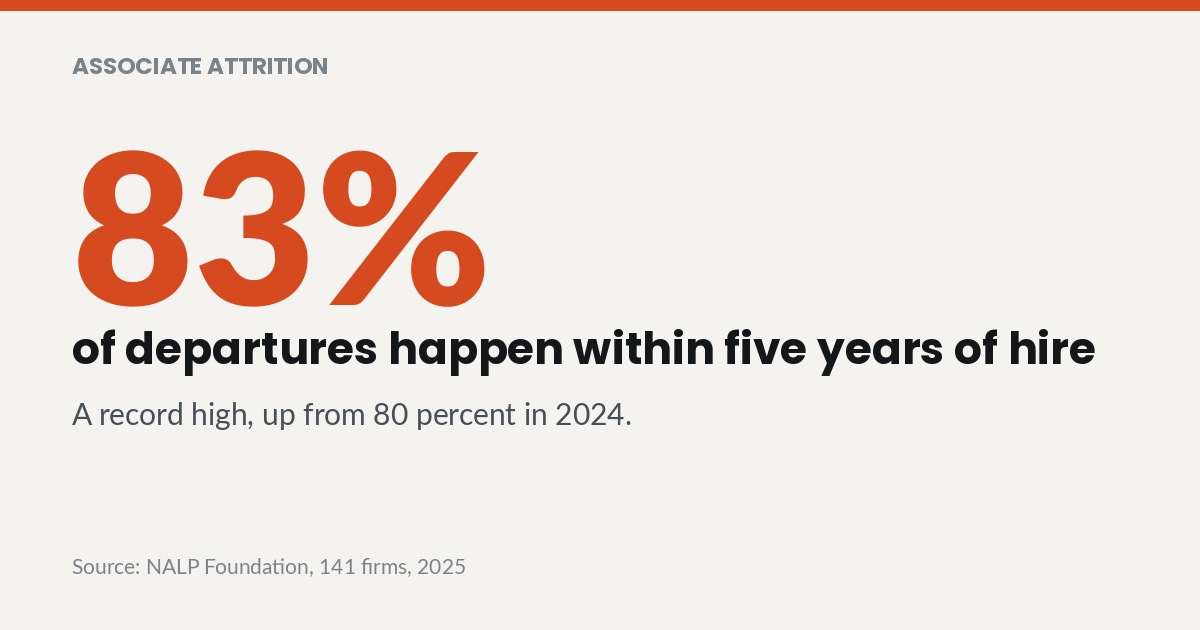
The same research found that 83 percent of associate departures occur within five years of hire. Smaller employers lose exactly the people who would have carried a change into its second year. Every rollout then starts from a partially new audience.
The choice of outside advisor belongs in this same discussion. Large firms frequently staff engagements with junior consultants running standard material, a mismatch described in paying for senior expertise and receiving junior staff with stale playbooks. Change work needs someone who has held operational accountability rather than someone presenting a template.
The failure pattern is consistent across every case above. Someone communicated a decision, and nobody owned the behavior after the message went out. Adoption is a management schedule with names attached rather than a communication problem. The memo is the beginning of the work, and most organizations treat it as the end.
Frequently Asked Questions
What does change management consulting actually do?
The work converts a decision into a set of observable behaviors with owners attached. A consultant maps who must act differently, what would make that easier and what would make it visible. The output is a schedule of reinforcement rather than a communication plan. Companies that skip this step announce change repeatedly and adopt it rarely.
Why did your team agree in the meeting and then change nothing?
Agreement in a meeting costs nothing, while the new method costs time at the desk. Quiet resistance usually signals that the change made the daily work harder in a way nobody acknowledged. The remedy is to find the cost and remove it rather than repeat the announcement. Teams keep methods that make the day easier and abandon methods that do not.
How long does a change take to stick?
Long enough for the behavior to survive a full turnover cycle in the affected roles. A change adopted by the current team but never written down disappears with the next departure. Documentation, onboarding and a visible measure carry a behavior past the people who learned it first. Timeframes matter less than whether those three supports exist.
Should leadership focus on managers or on the frontline?
Both, though the frontline decides whether the behavior survives the week. Managers can sponsor a change and still watch it fail when the people executing it turn over quickly. Stability at the manager level creates a false signal of adoption. Measuring the behavior at the point of work removes that illusion.
What makes culture change different from process change?
Process change alters the steps, while culture change alters what happens when nobody enforces the steps. A new process can be installed with training and a checklist. Culture shifts only when incentives, promotions and tolerated behavior all point in the same direction. Most culture programs fail because the promotion criteria never changed.
How do you tell an effective change consultant from a template?
Ask who will do the work and what that person has personally operated. Firms selling senior expertise and staffing junior consultants deliver standard material with a custom cover. An effective adviser asks about shift patterns, incentives and turnover before proposing anything. Someone who opens with a framework has not yet met the organization.
No comments:
Post a Comment
Note: Only a member of this blog may post a comment.