Vendor management consulting exists to make supplier risk visible before it turns into a service failure. The work is measurement and governance rather than negotiation. It means scoring suppliers on leading indicators and assigning internal ownership for every relationship. Deterioration is defined in advance, along with the person required to act on it.
Failure Is Visible Long Before It Is Felt
Vendor failure rarely arrives without warning. It arrives after a run of small signals that nobody was assigned to watch. Response times stretch, invoices start carrying new errors, and the account manager changes twice inside a single quarter.
Each of those signals is individually forgivable and easy to explain away. Together they describe a supplier under strain that has not yet missed anything contractual. Organisations that measure only contractual compliance cannot see the strain until it converts into a missed delivery.
The distinction that matters is between lagging and leading measurement. On-time delivery, defect rates and credit notes are lagging indicators that confirm damage already done. Quote turnaround, staff turnover on the account, invoice accuracy and responsiveness to non-urgent requests all move first.
The full argument for watching the early signals that precede a supplier failure instead of responding after the fact rests on that distinction. Prediction requires only information the business already receives. What is missing is a place to record it and a rule about what triggers action.
Assignment is where most vendor programmes fall down. A scorecard maintained by procurement alone measures commercial terms and misses operational reality. The people who experience deterioration first usually sit in operations, and their observations rarely reach a formal record.
The remedy is a shared record with a deliberately low reporting threshold. Frontline staff need somewhere to log a missed callback or a late confirmation without opening a formal dispute. Patterns only become visible once small observations are collected somewhere durable.
Segmentation comes before any of this measurement work. A supplier whose failure stops production requires different attention from one supplying office consumables. Applying identical rigour to every vendor guarantees that the ones that matter receive ordinary treatment.
Leading indicators also need a threshold and a named owner. A score that drifts without triggering anything is decoration rather than governance. Reviews belong on the calendar in advance, because a review convened after a failure is a post-mortem.
The Cost Lands on Customers, Not on the Contract
Supplier contracts allocate risk on paper. They do not allocate the damage that reaches the customer. A late component becomes a late order, a late order becomes a support ticket, and a support ticket becomes a decision about whether to reorder.
Penalty clauses recover a portion of the direct cost and none of the relationship. Customers rarely attribute a failure to a supplier they cannot see. They attribute it to the brand that took the order, which makes supplier risk into customer retention risk with a delay attached.
Long-tenured customers carry the most exposure to that chain of events. They order more often, so they meet the failure sooner and repeat the experience faster than anyone else. The case that one broken supplier costs the customer loyalty that took years to build follows directly from that exposure.
Supplier concentration multiplies the damage across the customer base. A supplier serving a single product line produces a contained failure, and a supplier embedded across several lines converts one disruption into a general one. Mapping which customers depend on which suppliers is unglamorous work that pays for itself during the incident.
Communication during a failure decides how much loyalty survives it. Customers forgive a disruption they were warned about and remember one they discovered themselves. That difference depends on how quickly the supplier signal reaches the people who talk to customers.
Retention analysis rarely reaches back into the supply base. Churn reviews interrogate pricing, product and service quality, then stop before reaching the operational cause. Connecting churned accounts to the fulfilment record that preceded them changes what those reviews conclude.
Freight Shows the Measurement Gap at Full Scale
Logistics is where unmeasured vendor cost is easiest to quantify, because the sector studies itself in public. Detention, the time a driver waits at a facility beyond the agreed window, is a cost created by the buyer and absorbed by the carrier. It almost never appears on the buyer's own ledger.
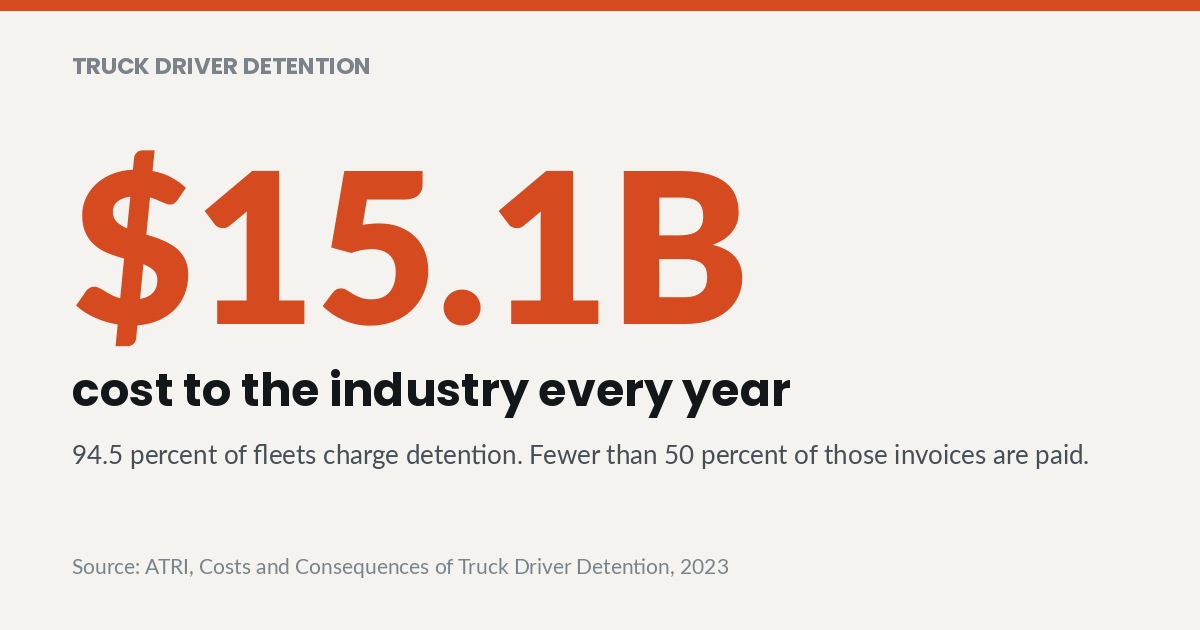
The American Transportation Research Institute put the cost of driver detention at $15.1 billion. That total splits into $3.6 billion of direct expense and $11.5 billion of lost productivity. The same 2023 research found that 39.3 percent of stops involve detention and 9.9 percent run beyond two hours.
Recovery of that cost is weak even where the billing exists. ATRI reported that 94.5 percent of fleets charge for detention and that fewer than 50 percent of those invoices are paid. A cost that is billed and never collected does not disappear from the system.
It returns as rate increases at renewal, as capacity quietly withheld from difficult facilities, and as carriers deprioritising the accounts that waste driver time. None of that registers as a vendor performance problem. It registers as a market that has become expensive for reasons nobody inside the business can explain.
Buyers also carry costs they never see quantified. Time spent by internal staff chasing a supplier, correcting invoices and replanning around late deliveries is real expense recorded nowhere. Adding that internal cost to the unit price changes which supplier looks cheap.
The lesson generalises well past trucking and freight contracts. Any vendor relationship contains costs created by the buyer and absorbed by the supplier, and those costs return with interest. Facilities and processes that waste supplier time pay for it in price, in priority and in willingness to help under pressure.
Liability follows the same pattern of knowable exposure. The Federal Motor Carrier Safety Administration does not require the cargo coverage that many shippers assume sits behind their freight. The examination of why liability for lost freight reaches the shipper without any federal insurance requirement covers a fully knowable risk.
Outsourcing Decisions Are Scored on the Wrong Ledger
Outsourcing is usually evaluated as a unit-cost comparison. Internal cost per unit sits against external cost per unit, with a transition allowance added on top. The comparison is clean and it excludes most of what actually happens afterwards.
Outsourced costs move somewhere else rather than disappearing. Coordination overhead lands on internal managers, quality variance lands on customers, institutional knowledge leaves with the displaced team, and remaining staff absorb the uncertainty. None of those items appear in the model that justified the decision.
Stakeholder impact is the missing column in that model. Employees, customers, communities and the vendor's own workforce each carry part of the transfer. Every one of those groups responds, through turnover, through churn or through degraded service that arrives without notice.
The case that the outsourcing calculation ignores the stakeholders who actually absorb the cost reframes the decision. It becomes a distribution question rather than a savings question. That reframing changes which options look attractive, and it changes how a transition is sequenced and communicated.
Transition planning receives far less scrutiny than the decision itself. Most outsourcing damage occurs during the handover, when documentation is thin and the departing team has already disengaged. Naming a transition owner with authority over both sides prevents the worst of it.
Reversal cost belongs in the model as well. Bringing a function back in-house after the internal team has dispersed costs far more than never moving it, and that asymmetry is rarely priced. A decision that cannot be reversed cheaply deserves a higher standard of evidence.
Better decisions come from scoring both ledgers at once. The financial model stays exactly as it is, and a second model records who bears each transferred cost and how they respond. Decisions that survive both tests survive contact with operating reality.
Good Vendors Decay From Neglect
Vendor management attention is spent almost entirely on problems. The supplier that fails receives meetings, escalation and scrutiny. The supplier that delivers receives silence, and silence is a management decision even when it is unintentional.
Reliable suppliers respond to neglect in entirely rational ways. Their best capacity goes to the accounts that engage with them. Pricing drifts upward without resistance, and their strongest people move toward relationships where the work is recognised. The observation that reliable vendors are the ones most likely to be taken for granted describes a slow loss.
Measurement should record excellence and not only deviation. Scorecards built purely on exceptions leave the best suppliers invisible in the reporting pack. A rating that identifies which relationships are worth protecting is as useful as one that identifies which are failing.
Payment behaviour is the clearest signal a buyer sends. Suppliers rank their accounts by how difficult it is to get paid, whatever the contract says. A business that pays on time without argument earns priority that no negotiation could purchase.
Recognition itself is cheap, specific and easy to schedule. A named internal contact, a review that is not about a complaint, early visibility of forecasts and prompt payment all cost very little. They buy priority during the periods when capacity is scarce, which is exactly when priority is worth having.
Every failure described here was knowable before it happened. Detention costs were measured and published, and liability sat in statute. The strained supplier was sending signals, and the reliable one had been ignored for a long stretch.
Vendor management is not a procurement function that activates when something breaks. It is the discipline of watching what is already visible and deciding in advance who acts on it.
Frequently Asked Questions
What does vendor management consulting actually deliver?
The output is a working measurement and governance system rather than a report. That means a supplier segmentation, a scorecard built on leading indicators, and named internal owners. A review calendar runs whether or not anything has gone wrong. Escalation thresholds are written down before they are needed, and the test of the work is whether problems get raised earlier than they used to.
How many suppliers should be managed this closely?
Only the ones whose failure would reach a customer or stop production. Most organisations find that a small group of suppliers carries the majority of operational risk, and everything else runs on standard purchasing controls. Managing every vendor at the same intensity guarantees that none of them is managed well. Segmentation is the first task rather than an afterthought.
Which leading indicators are worth tracking on a scorecard?
Quote turnaround time, responsiveness to routine requests, invoice accuracy, account team turnover and delivery timing all move before performance fails. Each of these is already observable inside normal operations. The difficulty is capture rather than availability of the data. A shared log that frontline staff will actually use matters more than the sophistication of the scoring model.
How often should formal vendor reviews take place?
Critical suppliers warrant a scheduled operational review every month and a commercial review each quarter. Lower-tier suppliers run on an annual cycle with exception reporting in between. The frequency matters less than the fact that reviews happen when nothing is wrong. Reviews that only occur after incidents train both sides to treat the relationship as adversarial.
Does this apply to agencies and service providers as well as physical suppliers?
Service vendors fail in the same pattern and often faster, because the warning signals are behavioural rather than physical. Slower responses, staff changes on the account and quietly reduced seniority on the work are the equivalent of late shipments. Service relationships also decay from neglect more readily, since the work is easier to deprioritise invisibly. The same scorecard logic applies with different indicators.
Who should own the vendor relationship inside the business?
Ownership belongs with the operational leader who feels the consequences of failure, supported rather than replaced by procurement. Procurement owns the contract and the commercial terms, while operations owns the performance relationship and the escalation. Splitting those roles clearly prevents the common situation where nobody is watching between renewals. Every critical supplier needs one name attached to it inside the business.
No comments:
Post a Comment
Note: Only a member of this blog may post a comment.